
Yetitva
Govern programs. Verify evidence. Decide with clarity.
Many perspectives. Shared understanding. Trusted decisions.
RiskFlow by Yetitva connects governance programs, assessments, evidence, and accountable decisions — so teams can see what is known, what remains uncertain, and why a conclusion is legitimate.
The business challenge
Governance work fragments before decisions are made
Programs, assessments, evidence packages, and accountability often live in disconnected tools. Leaders inherit fluent summaries that hide unknowns — and teams reopen the same questions without a shared trail.
Disconnected programs
Cyber, AI, vendor, and compliance work run in parallel tools with no shared ownership model.
Evidence without a trail
Questionnaires, exports, and reviews accumulate — but teams cannot see what was verified, when, or under which scope.
Decisions without context
Leaders inherit summaries that collapse unknowns into green or red, hiding uncertainty and accountability.
Introducing RiskFlow
One connected experience from program to reassessment
Through RiskFlow by Yetitva, these principles guide a product designed to connect findings and evidence, explain assurance, and support decisions people can defend.
01
Programs
Governance containers that organize ongoing assurance work with clear ownership.
02
Assessments
Bounded assurance activities linked to programs — or created standalone when needed.
03
Evidence & verification
Intake and review that preserve provenance, scope, and what remains unexamined.
04
Assurance
Structured conclusions that stay distinct from risk ratings and remediation tickets.
05
Risk & decisions
Authorized outcomes with rationale — accept, condition, escalate, or reject.
06
Reassessment
Continuous compliance posture derived from time-qualified evaluations, not static scores.
Product experience
Workspaces built for clarity, not dashboard theater
These screens show the intended RiskFlow workspace experience. Marketing does not invent sample conclusions or risk scores — and a hosted public demo is not available yet.
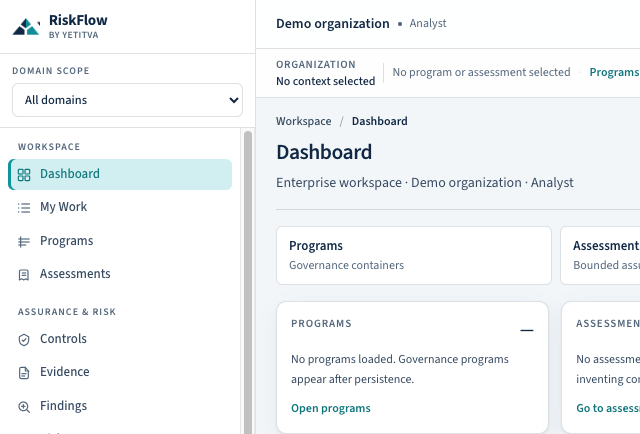
Enterprise Dashboard
Start from the enterprise workspace
See how governance work is organized so leaders and operators share one trail from programs through decisions — without collapsing unknowns into a single score.
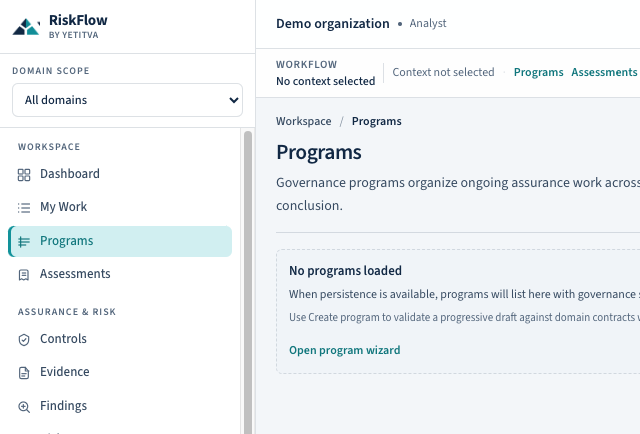
Programs
Own programs without collapsing assurance
Keep ongoing assurance work organized by purpose and accountability, while assurance conclusions stay tied to evidence and scope.
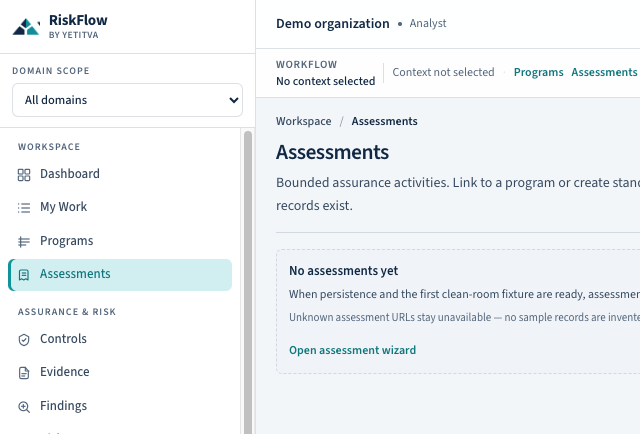
Context Ribbon
Stay oriented as work deepens
Understand where you are in organization, program, and assessment context while examining assignments and supporting materials.
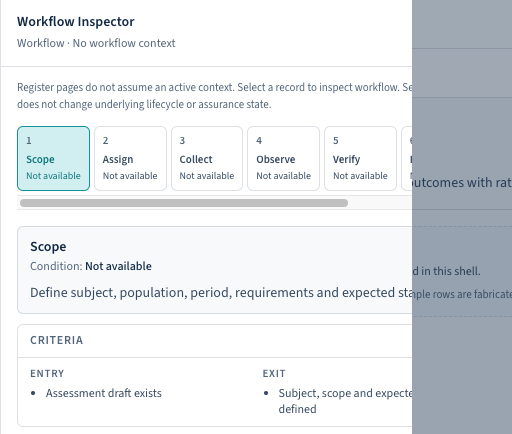
Workflow Inspector
Inspect workflow without inventing progress
Examine what a stage requires before asserting completion — so orientation never pretends that assurance or risk work is finished.
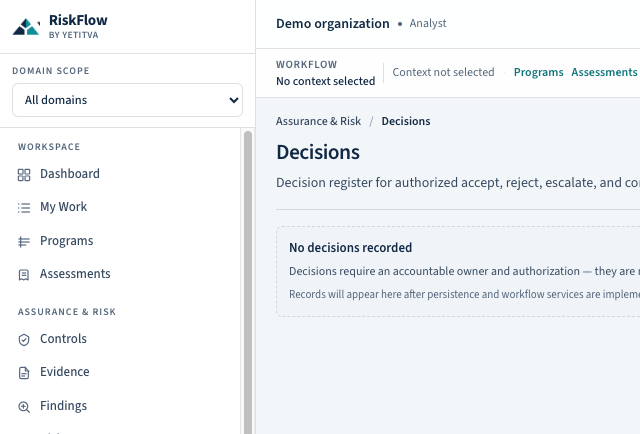
Registers & decisions
Record decisions people can defend
Support accept, condition, escalate, or reject outcomes with ownership and rationale — distinct from assurance state and risk rating.
Stakeholder Pyramid
Every level sees what matters. Everyone works from shared evidence.
Many perspectives. Shared understanding. Trusted decisions. Governance information often fragments as it moves between analysts, domain owners, program leadership, and executives. RiskFlow is designed so each level can focus on the decisions it owns — while remaining connected to the same underlying evidence.
UX concept — not a live role dashboard
Stakeholder pyramid levels. Use arrow keys to move between levels. Press Escape for the overview of all four levels.
Navy and teal bands echo brand perspectives. This diagram is not the Yetitva logo.
Select a level
Keyboard: arrows to move · Escape for overview
Overview
All four perspectives
Governance information often fragments as it moves between operators, domain owners, program leadership, and executives. Different levels need different density — but conclusions should stay connected to the same underlying evidence.
The Stakeholder Pyramid is a product storytelling model for those perspectives. It is not a live role-switching dashboard. Selecting a level shows the information and decisions that level needs — always over shared governance records.
Executive & Board
Set governance priorities, demand accountability, and authorize decisions that require enterprise authority.
GRC & Program Leadership
Own program objectives, assessment coverage, evidence gaps, and decision queues across domains.
Domain & Risk Owners
Prioritize domain-specific assessments, control and evidence conditions, treatments, and dependencies.
Analysts & Contributors
Collect observations, fulfill evidence requests, verify against criteria, and prepare findings for review.
Four integrated domains
Shared assurance across governance challenges
Cybersecurity, AI governance, third-party risk, and continuous compliance share one assurance model. Continuous Compliance is an ongoing, cross-domain capability whose posture is derived from scoped, time-qualified evaluations — not a fourth disconnected silo.
Cybersecurity Risk & Assurance
Challenge. Control claims outpace verification — enablement is mistaken for enforcement.
Supported decisions. What is established for scoped populations, what remains unknown, and which findings need treatment.
Stakeholder perspectives (design hypothesis)
- Executive. Material access and control uncertainties that need authority — without mistaking enablement charts for assurance.
- GRC & programs. Coverage across privileged and scoped populations; findings and re-verification queues.
- Domain owners. Control and evidence conditions; treatments when operation is not established.
- Analysts. Observations, evidence packages, and verification against scoped expectations — enablement is not enforcement.
AI Governance & Assurance
Challenge. Use cases, oversight, and evaluation evidence live in separate narratives.
Supported decisions. Whether an AI use case is ready to proceed, with limitations and evidence boundaries made explicit.
Stakeholder perspectives (design hypothesis)
- Executive. Proceed, hold, or condition use cases with limitations made explicit.
- GRC & programs. Use-case assessment coverage, oversight gaps, and decision queues.
- Domain owners. Evaluation evidence, oversight conditions, and dependency on shared controls.
- Analysts. Collect evaluation artifacts, record observations, and keep uncertainty visible.
Third-Party Risk & Assurance
Challenge. Vendor questionnaires close without a durable link from evidence to engagement decisions.
Supported decisions. Accept, condition, escalate, or exit — with rationale tied to scoped assurance work.
Stakeholder perspectives (design hypothesis)
- Executive. Accept, condition, escalate, or exit engagements with defensible rationale.
- GRC & programs. Vendor assessment progress, evidence gaps, and engagement decision queues.
- Domain owners. Contracted control conditions, linked findings, and treatment ownership.
- Analysts. Questionnaires and evidence intake tied to scoped reviews — not closed without a trail.
Continuous Compliance
Challenge. Compliance dashboards treat posture as a static score instead of derived, time-qualified assurance.
Supported decisions. Where requirements map to controls, how fresh the evidence is, and when reassessment is due — without treating Established as Compliant.
Stakeholder perspectives (design hypothesis)
- Executive. Where posture attention is due because evidence aged or scope changed — not a static enterprise score.
- GRC & programs. Derived posture from time-qualified evaluations across programs; reassessment cadence.
- Domain owners. Requirement-to-control mapping freshness within the domain’s scoped work.
- Analysts. Evidence freshness checks and reassessment tasks. Established is not Compliant; Unknown is not Non-compliant.
Brand promise
Turn assumptions into evidence-informed decisions.
Trust is earned through verification. Assurance explains what the evidence supports, under which conditions, and with what limitations.
Continue exploring RiskFlow
Review the product journey, methodology, or the Product Management Portfolio. A hosted demonstration is not publicly available yet — see Demo for current availability.