Yetitva

Product Management Portfolio

Flagship project

RiskFlow — Product Strategy, Design & Execution

An independent product initiative exploring how organizations can connect governance programs, assessments, evidence, assurance, risk and accountable decisions.

Turn assumptions into evidence-informed decisions.

  • HypothesisHypothesis
  • DesignedDesigned
  • ImplementedImplemented
  • VerifiedVerified

Labels mark hypothesis, design intent, implementation, or engineering verification — not product-market fit.

01 · Project overview

RiskFlow by Yetitva — portfolio product initiative

This page is a Product Management Portfolio project — not a customer case study or enterprise deployment story. It documents independent product management, design, and engineering work under the Yetitva brand.

Product
RiskFlow by Yetitva — evidence-grounded GRC assurance and decision platform.
Role demonstrated
Independent Product Management with hands-on product implementation — opportunity framing through working software evidence.
Vision & scope
One shared assurance core across cybersecurity, AI governance, third-party risk, and continuous compliance — with programs, assessments, evidence, and accountable decisions kept distinct.
Verified status today
Enterprise UX shell, workflow orientation, typed domain contracts, and product-led website. Persistence, live assurance engines, and hosted demo remain foundation / planned work — detailed below.

Many perspectives. Shared understanding. Trusted decisions. Clarity. Evidence. Assurance.

02 · Problem and opportunity

Governance work fragments before decisions can be defended

GRC teams often stitch together spreadsheets, tickets, questionnaires, and document stores. Evidence can exist without proving a requirement. Ratings can detach from scenario facts. Summaries can overclaim. Leaders inherit fluent narratives that hide what remains unknown — and teams reopen the same questions without a shared trail.

  • Fragmented programs

    Cyber, AI, vendor, and compliance work run in parallel tools with no shared ownership model or reassessment loop.

  • Disconnected assessments & evidence

    Collections accumulate without durable links from provenance and sufficiency to the conclusion someone is asked to trust.

  • Inconsistent organizational views

    Executives, program leads, domain owners, and operators see different decks — sometimes different “truths” — for the same underlying situation.

  • Assumptions mistaken for conclusions

    Unknown collapses into failure; enablement is mistaken for enforcement; remediation tickets close without re-verification.

  • Weak decision traceability

    Findings, risks, and accountable decisions lose the chain that would let a leader ask what evidence still supports the outcome.

  • Static compliance theater

    Posture is reported as a score instead of derived, time-qualified assurance — while evidence collection is repeated without continuity.

These failures matter because governance decisions allocate attention, capital, and accountability. When the trail is weak, organizations either over-trust polished summaries or under-trust everything — and neither path supports defensible action.

03 · Stakeholder research and needs

Different responsibilities. One evidence foundation.

Governance information must serve people with different responsibilities, information needs, and decision authority — while remaining grounded in a consistent body of evidence. Needs below are design hypotheses, not interview findings.

  • Executive and Board oversight

    Material uncertainties, enterprise priorities, and decisions that require authority — without drowning in assessment mechanics.

  • GRC and Program Leadership

    Program objectives, assessment coverage, evidence gaps, owners, deadlines, and decision queues — without mistaking program status for assurance.

  • Domain, Control and Risk Owners

    Domain-scoped assessments, control and evidence conditions, linked findings and treatments, and dependencies that may need escalation.

  • Operational Teams and Contributors

    Assigned work, evidence requests, observations, verification criteria, and outstanding actions that keep observation, finding, risk, and decision distinct.

Why the Stakeholder Pyramid is central

Many perspectives. Shared understanding. Trusted decisions. The pyramid is a product concept for serving representative organizational perspectives — not an exhaustive org chart and not a live role-switching dashboard. Direction and accountability flow downward; evidence, uncertainty, and decision requests flow upward; programs and assessments keep both connected.

Governance direction

Business objectives, risk appetite, policies, priorities, authority, and accountability travel downward into scoped work.

Assurance & risk intelligence

Evidence, observations, verification, findings, uncertainty, evaluated risks, escalations, and decision requests travel upward.

Shared foundation

Programs, requirements, controls, evidence, assurance records, provenance, and decisions — one substrate, many lenses.

Complementary capabilities

  • Stakeholder Pyramid — relevant perspectives and decision responsibilities.
  • Assurance Cube / Explorer — progressive exploration into evidence and detail (reserved in-app).
  • Risk Relationship Graph — typed dependencies and potential impacts for review (reserved; list/table fallback required).

UX concept — not a live role dashboard

Stakeholder pyramid levels. Use arrow keys to move between levels. Press Escape for the overview of all four levels.

Navy and teal bands echo brand perspectives. This diagram is not the Yetitva logo.

Select a level

Keyboard: arrows to move · Escape for overview

Overview

All four perspectives

Governance information often fragments as it moves between operators, domain owners, program leadership, and executives. Different levels need different density — but conclusions should stay connected to the same underlying evidence.

The Stakeholder Pyramid is a product storytelling model for those perspectives. It is not a live role-switching dashboard. Selecting a level shows the information and decisions that level needs — always over shared governance records.

  • Executive & Board

    Set governance priorities, demand accountability, and authorize decisions that require enterprise authority.

  • GRC & Program Leadership

    Own program objectives, assessment coverage, evidence gaps, and decision queues across domains.

  • Domain & Risk Owners

    Prioritize domain-specific assessments, control and evidence conditions, treatments, and dependencies.

  • Analysts & Contributors

    Collect observations, fulfill evidence requests, verify against criteria, and prepare findings for review.

Interactive website concept inspired by navy–teal organizational symbolism — not a modification of the Yetitva logo, and not operational role-aware product functionality.

04 · Product vision and strategy

Choices that keep evidence connected to decisions

RiskFlow by Yetitva is designed so organizations can govern programs, verify evidence, and record decisions people can defend. The decisions below consolidate strategy, prioritization, and alternatives into one place — without inventing workshops or interviews that did not occur.

From assumptions to informed decisions.

Clarity. Evidence. Assurance.

  • Designed

    Documented product direction

    One integrated GRC platform

    Product problem
    Cybersecurity, AI governance, third-party risk, and compliance work often run as parallel tools with incompatible semantics.
    Alternatives considered
    Four independent domain products with shared branding; one mega-module that collapses all workflows into a single undifferentiated queue.
    Selected approach
    One RiskFlow product with a shared assurance foundation and domain-specific subjects and journeys.
    Why
    Shared primitives compound product value and prevent “executive truth” from diverging from operational records.
    Trade-off
    Slower domain-specific storytelling early on; requires discipline to keep Continuous Compliance derived rather than siloed.
  • Implemented

    Documented product direction

    Programs as first-class governance entities

    Product problem
    Assessments without durable governance containers lose ownership, continuity, and reassessment context.
    Alternatives considered
    Assessment-only folders; ticketing systems as the system of record; program labels without lifecycle meaning.
    Selected approach
    Programs organize ongoing assurance work with purpose, domain scope, and ownership — distinct from assurance conclusions.
    Why
    Leaders need continuity; operators need a place for linked assessments without inventing compliance scores from program status.
    Trade-off
    Requires clear UX that program health is not Established/Compliant; persistence must catch up to the shell.
  • Implemented

    Documented product direction

    Assessments as distinct evaluation workflows

    Product problem
    Bounded evaluation work gets lost inside programs, tickets, or document stores without reusable workflow structure.
    Alternatives considered
    One endless program checklist; questionnaires as the entire product; assessments that auto-assert assurance.
    Selected approach
    Assessments are distinct, reusable evaluation workflows that can link to programs or stand alone when needed.
    Why
    Scope, period, population, and evidence expectations need a bounded container before conclusions are asserted.
    Trade-off
    Draft validation exists today; persistence-backed assessment libraries remain the next foundation step.
  • Designed

    Documented product direction

    Evidence-grounded assurance over generic summaries

    Product problem
    Fluent narratives and static scores hide uncertainty, weak provenance, and time-bounded scope.
    Alternatives considered
    LLM-first executive briefs; traffic-light dashboards; pass/fail checklists without provenance.
    Selected approach
    A designed Assurance Reasoning Engine producing structured conclusions, followed by a designed Assurance Expression Engine that composes governed explanations without inventing facts.
    Why
    Turn assumptions into evidence-informed decisions requires verification before assertion — not polished prose as a substitute for evidence.
    Trade-off
    Reasoning and expression packages are scaffolded, not claimed as live production engines.
  • Designed

    Documented product direction

    Risk evaluation distinct from assurance state

    Product problem
    Teams often treat a control gap or assurance shortfall as if it automatically set likelihood, impact, and residual risk.
    Alternatives considered
    Derive risk scores from assurance states; hide Not Rated; mechanically discount inherent risk whenever a control is marked implemented.
    Selected approach
    Risk scenario models with separate inherent and residual evaluations, qualitative 5×5 prototype direction, explicit Not Rated, and authorized treatment decisions.
    Why
    A gap creates a risk condition candidate — not a rating. Control credit requires effectiveness assumptions that can be verified.
    Trade-off
    Slower “score-first” storytelling; live quantification and calibrated bands remain planned, not current product behavior.
  • Designed

    Documented product direction

    Stakeholder-specific perspectives over shared records

    Product problem
    Different organizational levels need different density and decision focus, but offline “executive versions” create dual truths.
    Alternatives considered
    One generic dashboard for everyone; four separate role products; client-side role switching as authorization.
    Selected approach
    A Stakeholder Pyramid product concept: perspectives change information needs and decisions — not underlying facts — over shared programs, assessments, evidence, and decisions.
    Why
    Different perspectives. Connected by evidence. Authority and presentation must remain separate from authentication.
    Trade-off
    Website interaction is a labeled UX concept; role-aware application aggregation awaits authorization and data foundations.
  • Implemented

    Documented product direction

    Contextual Workflow Ribbon and Inspector

    Product problem
    Deep GRC workflows lose orientation; large workflow pages compete with the work itself.
    Alternatives considered
    A large dedicated workflow navigator page; breadcrumbs alone; inventing lifecycle progress from UI selection.
    Selected approach
    A compact Context Ribbon under the header plus a right-side Workflow Inspector for stage criteria without advancing state.
    Why
    Operators need persistent orientation; inspecting a stage must not invent lifecycle or assurance progress.
    Trade-off
    Orientation UX can look “complete” while persistence and engines are still incomplete — honesty labels remain mandatory.
  • Designed

    Documented product direction

    Continuous Compliance as derived oversight

    Product problem
    Compliance dashboards treat posture as a static score detached from scoped, time-qualified assurance work.
    Alternatives considered
    A fourth disconnected compliance product; equating Established with Compliant; inventing enterprise scores from incomplete evidence.
    Selected approach
    Continuous Compliance as ongoing cross-domain oversight whose posture is derived from supported evaluations and reassessment triggers.
    Why
    Reuse the same assurance records; keep Established distinct from Compliant and Unknown distinct from Non-compliant.
    Trade-off
    Harder to market as a simple score; requires time, scope, and freshness discipline in the data model.
  • Implemented

    Documented product direction

    Incremental implementation over an all-at-once platform

    Product problem
    Building engines, graphs, cubes, and role dashboards before a credible workflow produces demos that look finished and behave dishonestly.
    Alternatives considered
    Ship decision-intelligence visuals first; freeze marketing until full engines exist; invent sample data to fill empty registers.
    Selected approach
    Ship navigable workspaces and honest empty states first; deepen engines, persistence, and intelligence after operators have a place to work.
    Why
    A first credible workflow needs programs, assessments, evidence intake paths, and accountable decision surfaces — not decorative analytics.
    Trade-off
    Portfolio storytelling must stay disciplined; scaffolding is not an end-to-end governance platform.

05 · Product requirements and MVP prioritization

What makes the first credible RiskFlow workflow

The first credible product experience is not a decorative intelligence layer. It is a path where an operator can enter governance context, run bounded evaluation work, keep uncertainty visible, and prepare accountable decisions — without inventing records to look finished.

  1. 01 · Foundation

    Shared brand, domain contracts, and independently deployable website and RiskFlow applications.

  2. 02 · Working assessment workflow

    Enter a program or assessment context, stay oriented, collect and review evidence pathways, and keep empty registers honest until records exist.

  3. 03 · Trustworthy assurance

    Structured evaluation that preserves Unknown, sufficiency, and provenance — engines designed before they are claimed live.

  4. 04 · Accountable decisions

    Human outcomes with rationale and ownership, distinct from assurance state and risk rating.

  5. 05 · Decision intelligence

    Stakeholder perspectives, progressive exploration, and relationship review over the same records — reserved until authorization and data foundations land.

Essential now

Navigable enterprise shell, program and assessment entry, orientation (Ribbon / Inspector), honest empty registers, and clear separation of observation, finding, assurance, risk, and decision concepts.

Differentiated, deliberately deferred

Live assurance/expression engines, role-aware pyramid aggregation, Cube exploration, and relationship graphs — designed as complementary intelligence over shared records, not prerequisites for a usable shell.

06 · Product design and UX decisions

How product decisions become usable workflows

Strategy becomes orientation first: enter a program or assessment, stay located, keep empty registers honest, and reserve intelligence surfaces until authorization and data exist. Working screens below are real application captures — not invented metrics.

Status labels mark what operators can use today versus designed concepts. The inventory supports the decisions above; it is not a product-market-fit claim.

  • Organization → Program hierarchy

    Implemented

    Enterprise shell frames organization workspace and program containers.

  • Program creation & governance setup

    Implemented

    Program draft/entry UX with honest empty states; persistence still foundation work.

  • Assessment creation & assignment

    Implemented

    Progressive draft validation exists; unknown URLs do not invent sample records.

  • Dashboard & My Work

    Implemented

    Operational entry points and queues with empty states — not fabricated attention metrics.

  • Workflow Context Ribbon

    Implemented

    Sticky orientation under the header across operational routes.

  • Workflow Inspector

    Implemented

    Right-side stage inspection with entry/exit criteria; selection does not advance state.

  • Stakeholder Pyramid

    Designed

    Website interactive UX concept; application Perspectives route reserved.

  • Assurance Cube / Explorer

    Designed

    Planned progressive exploration; navigation hierarchy establishes the drill model first.

  • Risk Relationship Graph

    Designed

    Planned typed dependency review with mandatory list/table fallback; not causal automation.

  • Risk evaluation workspace

    Designed

    Registers and navigation stubs exist; scenario scoring and inherent/residual UX remain designed.

  • Contextual assistant

    Designed

    In-app shell exists; live AI responses are disabled and must never invent ratings or approve decisions.

RiskFlow
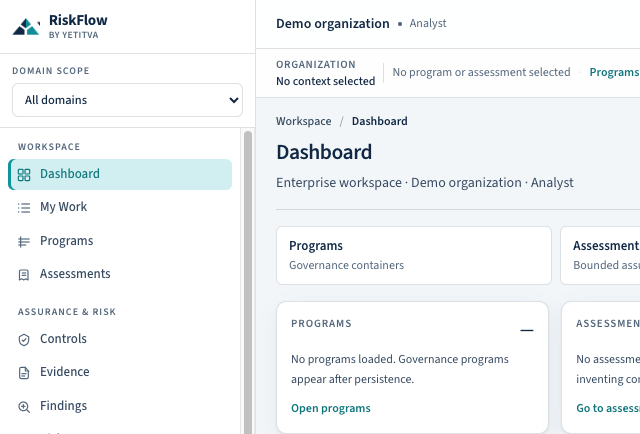
RiskFlow enterprise dashboard
Working application UIImplemented interface — enterprise dashboard framing programs, assessments, evidence, and decisions as connected work.
  1. 01 · Workspace journey

    Programs → Assessments → Evidence → Decisions framed as connected work, not isolated modules.

  2. 02 · Honest empty states

    No invented program counts or risk heatmaps. Persistence is the next foundation step.

  3. 03 · Decision intelligence stubs

    Perspectives, Explorer, and Relationships are reserved — labeled as future depth, not live aggregation.

RiskFlow
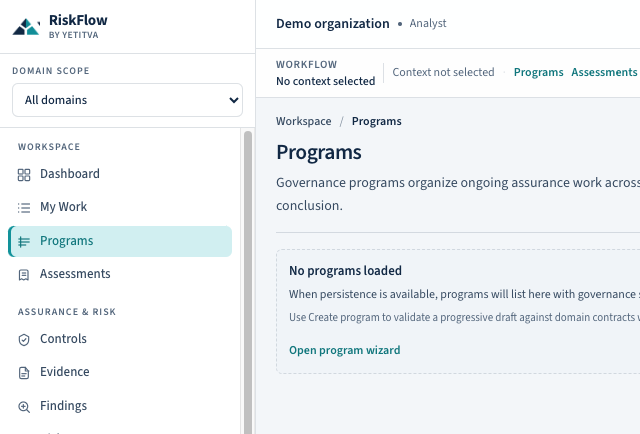
RiskFlow programs workspace
Working application UIImplemented interface — program workspace with domain scope and workflow context.
  1. 01 · Programs as containers

    Governance continuity without treating program status as an assurance conclusion.

  2. 02 · Domain scope

    Focus across cybersecurity, AI, third-party, and compliance without four siloed apps.

RiskFlow
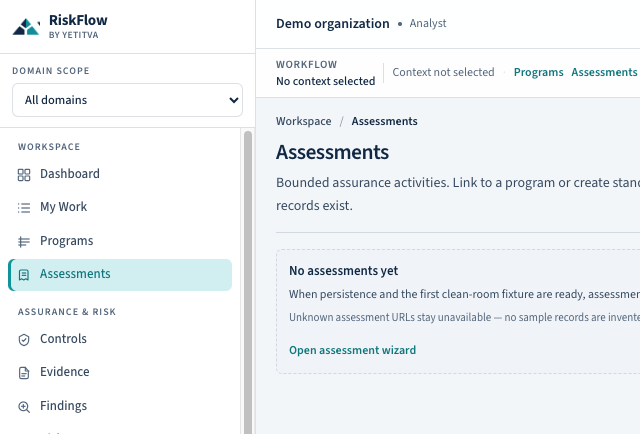
RiskFlow assessments with context ribbon
Working application UIImplemented interface — assessments workspace with Workflow Context Ribbon.
  1. 01 · Context Ribbon

    Sticky orientation so operators know organization/program/assessment context — or its absence.

  2. 02 · Draft before persistence

    Create assessment validates progressive drafts; unknown URLs do not invent sample records.

RiskFlow
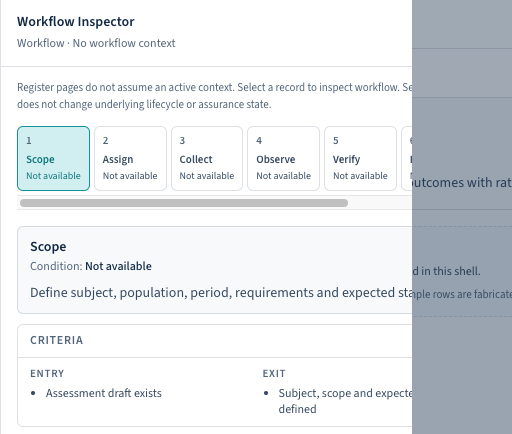
RiskFlow Workflow Inspector panel
Working application UIImplemented interface — Workflow Inspector stage criteria without inventing lifecycle progress.
  1. 01 · Stage inspection

    Stages can be inspected; selection does not advance assurance state.

  2. 02 · Visible uncertainty

    Entry/exit criteria remain visible even when condition is Not available.

07 · Assurance Reasoning & Expression design

Why rules-based reasoning precedes governed language

These are product-design decisions for the Assurance Reasoning Engine and Assurance Expression Engine. Canonical algorithms remain in approved specifications; packages are scaffolded — not live production engines.

Reasoning design decisions

  • Evidence presence ≠ requirement met. Sufficiency, provenance, population coverage, and time qualification decide what can be established.
  • Five explicit states. Established, Partially Established, Not Established, Unknown, and Conflicting keep uncertainty and conflict visible instead of collapsing into pass/fail.
  • Enablement ≠ enforcement. Configuration that allows a control is not proof it operates for the scoped population.
  • Reasoning cannot silently rate risk. Assurance conclusions may identify a risk condition; likelihood and impact remain a separate evaluation.

Expression design decisions

  • Constructs, not free prose. Statements compose from governed assurance constructs and a structured conclusion — the original differentiator is programmatic composition, not “AI summarizes GRC.”
  • Source-grounded clauses. Material language should remain linkable to evidence, measurements, and reasoning steps.
  • Audience variants preserve meaning. Executive and analyst modes may change density; they must not change state, scope, or uncertainty.
  • Deterministic baseline. Optional AI assistance may propose phrasing later; it must not invent facts or upgrade conclusions.

UX implication

Product surfaces must show state, uncertainty, and provenance before narrative polish. Audience-specific wording is a presentation choice over the same structured conclusion — demonstrated on Product and Methodology, not duplicated here as a second interactive engine mock.

08 · Risk evaluation design

Why risk needs its own product requirements

Risk Evaluation & Decision Intelligence is a substantial capability — not a color derived from assurance state. Each row follows problem → decision → trade-off for the UX and data model.

  • Scenario models first

    Problem. Gaps were treated as if they already set likelihood and impact. Decision. Require subject, exposure, threat/trigger, event, consequence, and horizon before a rating path opens. Trade-off. Slower “score-first” demos; honest empty risk until inputs exist.

  • Inherent vs residual surfaces

    Problem. Implemented controls were assumed to reduce risk automatically. Decision. Separate inherent and residual evaluations with explicit baselines and effectiveness assumptions. Trade-off. More fields and explanation; no silent discounts.

  • Not Rated is first-class UI

    Problem. Empty registers invite invented Moderate scores. Decision. Missing required inputs stay Not Rated — including when an assurance gap is known. Trade-off. Harder marketing visuals; consistent with brand honesty.

  • Treatment and authority

    Problem. Remediation tickets and assistant suggestions looked like decisions. Decision. Treatment, acceptance, escalation, and reassessment need owned records distinct from assurance expressions. Trade-off. More workflow states before “done.”

Qualitative 5×5 (RF-RISK-5X5) remains the approved prototype direction — prioritization index, not calibrated probability. Interactive evaluation illustration and full rules live on Product and Methodology.

09 · From product design to working software

What has genuinely been built

Delivery evidence is kept short here so the PM narrative stays primary. A working interface shell is not a production-ready governance platform.

  1. 01

    Implemented

    Shared project foundation

    Monorepo with independently deployable website and RiskFlow apps plus shared UI and domain packages.

  2. 02

    Verified

    Domain contracts & state tests

    Typed governance/assurance contracts with automated tests for identifiers, assurance states, and Not Rated risk handling.

  3. 03

    Implemented

    Program & Assessment UX shell

    Dashboard journey, program/assessment entry points, registers, and honest empty states.

  4. 04

    Implemented

    Workflow Ribbon & Inspector

    Persistent orientation and stage inspection without inventing lifecycle or assurance progress.

  5. 05

    Implemented

    Website & brand experience

    Product-led Yetitva site, messaging registry, Stakeholder Pyramid storytelling concept.

Optional technical depth

Implementation baseline includes TypeScript, Next.js apps in an npm workspace, Tailwind, and shared domain/UI packages. Persistence and hosting choices remain engineering decisions documented elsewhere — not the primary PM story.

10 · Validation, trade-offs and lessons

What we can support — and what remains open

Verified means a specific claim was checked through engineering or contract tests. It does not mean customers adopted the product. Design hypotheses remain labeled until validated.

  • Product design validation

    Hypothesis

    Stakeholder needs and persona framing used to guide definition. No customer interviews, pilots, or usability studies are claimed on this page.

    Needs remain design hypotheses. Assumptions await future validation with cleared scenarios and real users.

  • Engineering verification

    Verified

    Typecheck, lint, and production builds for website and RiskFlow workspaces; browser interaction checks for public site experiences.

    Used continuously for foundation slices. Verifies specific engineering claims — not product-market fit.

  • Domain & methodology verification

    Implemented

    Automated domain package tests for shared contracts and state semantics (including Not Rated).

    Contract-level coverage exists. Golden assurance-engine tests and full scenario journeys remain pending engines and persistence.

  • End-to-end workflow proof

    Designed

    Planned Playwright coverage for program → assessment → evidence → decision once persistence-backed records exist.

    Not claimed as complete. Empty registers are not treated as finished journeys.

Trade-offs and lessons so far

  • Separate brand site from product shell

    Yetitva.com narrates opportunity and strategy; RiskFlow carries operational UX. Mixing them produced either a thin landing page or an engineering status dump.

  • Programs as first-class entities

    Assessment-only structures could not carry ownership and continuity. Programs organize work — without being mistaken for assurance conclusions.

  • Ribbon and Inspector over a giant navigator

    A large workflow detail page competed with the work. Compact context under the header, with inspect-on-demand criteria, keeps orientation without inventing progress.

  • Honest empty states over fabricated dashboards

    Inventing metrics to fill registers would contradict the brand promise. Empty is harder to market and easier to trust.

  • Perspectives must share one evidence foundation

    Role-aware views that invent separate truths recreate the original fragmentation problem. Different perspectives. Connected by evidence.

  • Continuous Compliance reuses assurance records

    Treating compliance as a fourth silo would duplicate evidence work. Derived posture preserves time, scope, and reassessment discipline.

  • UI role switching is not authorization

    Perspective presentation cannot replace authentication, server-side authorization, or provenance. The reserved Perspectives route states this explicitly.

11 · Next steps and future assurance journeys

Representative workflows being prepared — not published assurance case studies

Future RiskFlow Assurance Case Studies will demonstrate publication-approved fictional scenarios across four domains. The cards below describe intended journeys only. They are not customer stories and are not delivered outcomes.

Hypothesis

Journey in development

Cybersecurity Risk & Assurance

Challenge. Control claims outpace verification; enablement is mistaken for enforcement.

Intended evaluation journey. Scoped control evaluation from evidence package through explainable assurance, treatment options, and accountable decision.

Future assurance journey structure

  1. Challenge
  2. Scope
  3. Stakeholders
  4. Evidence
  5. Evaluation
  6. Assurance
  7. Risk
  8. Decision
  9. Reassessment

Scenario awaiting implementation and publication approval. No source-derived records or invented assurance scores will be published here.

Hypothesis

Journey in development

AI Governance & Assurance

Challenge. Use cases, oversight, and evaluation evidence live in separate narratives.

Intended evaluation journey. Use-case readiness with explicit limitations, evidence boundaries, and proceed / hold / condition outcomes.

Future assurance journey structure

  1. Challenge
  2. Scope
  3. Stakeholders
  4. Evidence
  5. Evaluation
  6. Assurance
  7. Risk
  8. Decision
  9. Reassessment

Reserved for an approved synthetic journey. No interview quotes or private dataset excerpts.

Hypothesis

Journey in development

Third-Party Risk & Assurance

Challenge. Vendor questionnaires close without a durable link from evidence to engagement decisions.

Intended evaluation journey. Accept / condition / escalate / exit with rationale tied to scoped assurance work.

Future assurance journey structure

  1. Challenge
  2. Scope
  3. Stakeholders
  4. Evidence
  5. Evaluation
  6. Assurance
  7. Risk
  8. Decision
  9. Reassessment

Awaiting a clean-room vendor scenario. Will not invent adoption rates or assurance conclusions.

Hypothesis

Journey in development

Continuous Compliance

Challenge. Compliance reporting treats posture as a static score instead of derived, time-qualified assurance.

Intended evaluation journey. Requirement-to-control mapping, evidence freshness, and reassessment triggers across domains.

Future assurance journey structure

  1. Challenge
  2. Scope
  3. Stakeholders
  4. Evidence
  5. Evaluation
  6. Assurance
  7. Risk
  8. Decision
  9. Reassessment

Structure reserved. Continuous Compliance remains cross-domain oversight — not a fourth evidence silo.


Next meaningful product decisions

  1. Land persistence-backed program and assessment records without inventing conclusions.
  2. Implement deterministic Assurance Reasoning and governed Expression against cleared fixtures — then claim only what golden tests prove.
  3. Land risk-scenario evaluation UX with inherent/residual separation, Not Rated honesty, and treatment authority — without deriving scores from assurance state.
  4. Define authorization-aware perspective summaries before treating pyramid aggregation as operational.
  5. Publish assurance journey demonstrations only after fictional scenarios clear review — never from private source-derived datasets, and never as customer claims.

Continue from assumptions to informed decisions

Explore the product journey, methodology foundations, or the portfolio landing page. This project narrative will deepen as implemented evidence and cleared domain scenarios land — without rewriting history as traction.