

Yetitva

RiskFlow by Yetitva

From assumptions to informed decisions.

A program-driven, evidence-grounded GRC assurance platform — connecting governance objectives, programs, assessments, evidence, assurance, risk evaluation, treatment, and accountable decisions people can defend.

Through RiskFlow by Yetitva, these principles guide a product designed to connect findings and evidence, explain assurance, and support decisions people can defend.

RiskFlow
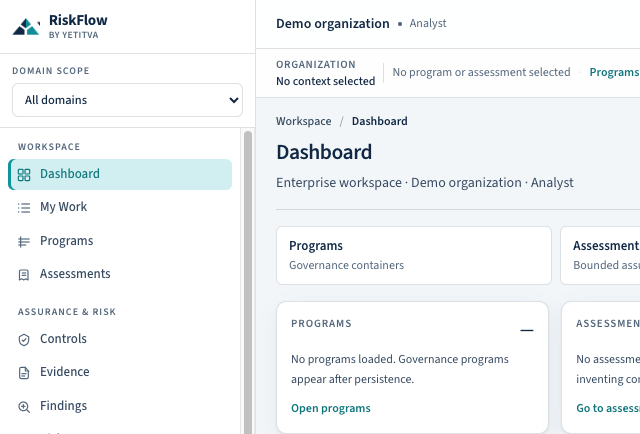
RiskFlow enterprise dashboard
Product previewA preview of RiskFlow’s connected governance workspace.

Built for organizational value first

RiskFlow is designed around the work people actually do: owning programs, running assessments, verifying evidence, explaining assurance, evaluating risk, and deciding with accountability. Technical differentiation supports that journey — it does not replace it.

RiskFlow
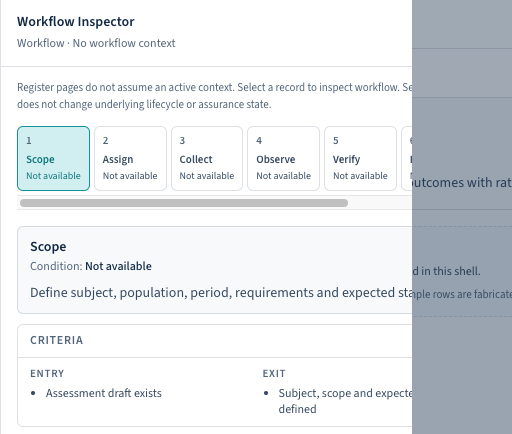
RiskFlow Workflow Inspector
Product previewWorkflow Inspector — examine stage criteria and supporting information without inventing progress.
RiskFlow
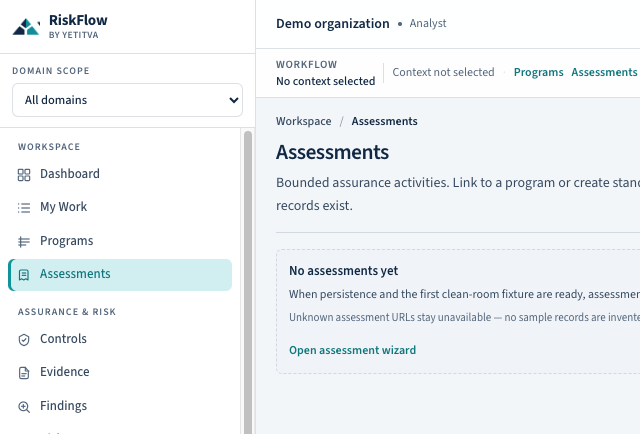
RiskFlow assessments with context ribbon
Product previewAssessments workspace with Context Ribbon — stay oriented as evaluation work deepens.
  1. Program-driven governance

    Organize ongoing assurance work inside governance programs — not ad-hoc folders of questionnaires.

    Programs carry business objectives, domain scope, ownership, and continuity. Policies, requirements, and obligations stay attached to scoped work. Program status describes governance activity; it is never treated as an assurance conclusion or compliance score.

  2. Clear ownership and scope

    Every assessment needs a subject, population, period, and accountable roles before conclusions are asserted.

    RiskFlow keeps scope visible as work progresses so teams do not silently expand claims beyond what was examined. Domain scope helps operators focus without splitting the product into four siloed apps.

  3. Connected assessments

    Bounded assurance activities link to programs when they belong there — or stand alone when the work requires it.

    Assessments carry workflow orientation through the Context Ribbon and Inspector so reviewers understand where they are without inventing lifecycle or assurance state.

    Assessment drafting and validation are available in the current product preview. Saved operational assessment libraries remain under development.

  4. Evidence and verification

    Intake and review preserve provenance, timing, and sufficiency — before any conclusion is asserted.

    Evidence packages are reviewed against scoped expectations. Verification stays distinct from observation and from remediation tickets closed without re-checking operation. Enablement is not enforcement.

  5. Assurance Reasoning Engine

    Deterministic, explainable comparison of expected versus observed conditions — with unknowns kept visible.

    The designed Assurance Reasoning Engine evaluates requirements, evidence relevance and sufficiency, conflicts, scope, and temporal boundaries to produce structured assurance conclusions. Canonical states: Established, Partially Established, Not Established, Unknown, and Conflicting. Unknown is not treated as failed.

    Assurance Reasoning is a designed capability and is not yet available as a live evaluator.

  6. Assurance Expression Engine

    Governed natural-English explanations from structured conclusions — not unconstrained AI summaries.

    Its Assurance Expression Engine is designed to turn structured findings, evidence, and reasoning into substantive, traceable explanations. Audience variants may change language and density; they must not change underlying facts, assurance state, or uncertainty.

    Assurance Expression is a designed capability. The audience demonstration below is a conceptual illustration — not live engine output.

  7. Risk Evaluation & Decision Intelligence

    Risk scenarios, inherent and residual evaluation, treatment, and accountable decisions — separate from assurance state.

    Teams frame threats, exposure, and consequences; assess likelihood and impact; distinguish inherent from residual risk; and record treatment and acceptance with ownership. Risk rating remains Not Rated until assessed. Assurance state does not set the risk score.

    Risk evaluation concepts and decision framing are part of the product design. Live quantification and automated risk conclusions are not product behavior today.

  8. Stakeholder-specific perspectives

    Executives, GRC and program leadership, domain owners, and operational teams need different lenses on the same underlying information.

    The Stakeholder Pyramid describes those information and decision needs across the organization. Interactive storytelling on this page is a UX concept — in-product role-aware perspectives remain designed and are not yet operational. Perspective selection is not permission and not decision authority.

  9. Exploration, relationships, and orientation

    Context Ribbon and Workflow Inspector keep orientation as teams move from enterprise → program → assessment → evidence.

    Assurance Cube is designed so teams can explore governance information progressively — from a broad view into supporting details, with a path back to higher context. Risk Relationship Graph is designed to surface relevant dependencies and potential impacts that require review — correlation is not causality, and graphs do not auto-change ratings. Selecting a workflow stage for inspection does not invent lifecycle progress.

  10. Four-domain continuity and reassessment

    Continuous Compliance is an ongoing governance capability whose posture is derived from scoped, time-qualified assurance evaluations.

    Cybersecurity, AI governance, third-party risk, and Continuous Compliance share one assurance core. Established is not Compliant. Reassessment closes the loop when evidence ages or scope changes.

Stakeholder Pyramid

Every level sees what matters. Everyone works from shared evidence.

Many perspectives. Shared understanding. Trusted decisions. Explore how the same conceptual governance situation can be considered from four perspectives — without inventing assessment results, metrics, or live authorization behavior.

UX concept — not a live role dashboard

Stakeholder pyramid levels. Use arrow keys to move between levels. Press Escape for the overview of all four levels.

Navy and teal bands echo brand perspectives. This diagram is not the Yetitva logo.

Select a level

Keyboard: arrows to move · Escape for overview

Overview

All four perspectives

Governance information often fragments as it moves between operators, domain owners, program leadership, and executives. Different levels need different density — but conclusions should stay connected to the same underlying evidence.

The Stakeholder Pyramid is a product storytelling model for those perspectives. It is not a live role-switching dashboard. Selecting a level shows the information and decisions that level needs — always over shared governance records.

  • Executive & Board

    Set governance priorities, demand accountability, and authorize decisions that require enterprise authority.

  • GRC & Program Leadership

    Own program objectives, assessment coverage, evidence gaps, and decision queues across domains.

  • Domain & Risk Owners

    Prioritize domain-specific assessments, control and evidence conditions, treatments, and dependencies.

  • Analysts & Contributors

    Collect observations, fulfill evidence requests, verify against criteria, and prepare findings for review.

Complementary capabilities

  • Stakeholder Pyramid — defines information needs and decision responsibilities by organizational level.
  • Assurance Cube / Explorer — designed for progressive exploration from broad governance views into supporting details (designed capability; not operational here).
  • Risk Relationship Graph — designed to surface relevant dependencies and potential impacts for review, with a list/table alternative (designed capability; not operational here).

All three are intended to operate over the same programs, assessments, evidence, and decisions — not as disconnected features.

Bidirectional governance

Direction and accountability flow downward. Evidence, risks, and feedback flow upward — connected through program and assessment records, not through invented enterprise aggregation.

Top-down

Direction and accountability

  1. Strategic objectives
  2. Scope & priorities
  3. Governance requirements
  4. Decisions & accountable actions

Connected through

Programs & assessments

Summaries are designed to link to supporting records for authorized users. RiskFlow does not invent automated enterprise risk ratings from raw evidence.

Bottom-up

Evidence and feedback

  1. Observations & evidence
  2. Verification & findings
  3. Uncertainty & exposure signals
  4. Escalations & decision requests

Assurance Reasoning & Expression

Explainable assurance — then governed language

Reasoning determines what the evidence supports. Expression communicates that conclusion without inventing facts. Both are designed differentiators of RiskFlow; neither is claimed as a live production engine today.

Assurance Reasoning Engine

  • Requirements and expected states for a scoped population and period.
  • Observations, evidence relevance, sufficiency, and provenance.
  • Verification criteria, gaps, conflicts, and temporal boundaries.
  • Structured conclusions using Established, Partially Established, Not Established, Unknown, and Conflicting.
  • Conditions that require reassessment when evidence or scope changes.

Assurance Expression Engine

  • Composition from governed assurance constructs and structured conclusions.
  • Semantic accuracy with evidence references and explicit limitations.
  • Assurance state, reasoning justification, scope, and temporal context.
  • Audience variants that preserve source meaning and uncertainty.
  • Separation from unconstrained AI prose and from risk-rating invention.

Assurance Expression — conceptual illustration

Audience changes language and density. It must not change assurance state, scope, uncertainty, or risk status.

  • Expected MFA coverage: 100% of 250 privileged accounts
  • Observed: 240 enabled (96%) — Partially Established
  • Risk condition identified; likelihood and impact not assessed — Not Rated

Decision-oriented language; same facts, less mechanics.

Privileged-account MFA is only partially established for the assessed production population: 240 of 250 accounts meet the required condition. The remaining gap creates a potential unauthorized-access risk condition. Likelihood and impact have not been assessed, so risk remains Not Rated. Remediation and current evidence are needed before the required state can be restored.

Labeled concept only — not output from a live Assurance Expression Engine, and not a published assessment result.

Risk Evaluation & Decision Intelligence

From risk scenario to accountable decision

RiskFlow treats risk evaluation as its own discipline: scenario framing, inherent and residual assessment, control effectiveness, treatment, and authorized decisions — never inferred solely from an assurance state.

  1. 01

    Risk scenario

    Subject, exposure, threat or trigger, adverse event, consequence, and assessment horizon — a gap alone is not a rating.

  2. 02

    Inherent risk

    Explicit counterfactual baseline with named controls excluded and conditions retained. Requires its own likelihood and impact rationale.

  3. 03

    Controls & effectiveness

    Design, implementation, and operating effectiveness are separate inputs. Enablement is not enforcement; implemented is not verified.

  4. 04

    Residual risk

    Separately supported reassessment considering current controls and actual effectiveness — never a silent automatic discount.

  5. 05

    Treatment & decision

    Mitigate, avoid, transfer/share, accept, monitor, or investigate. Acceptance and escalation require recorded authority.

Qualitative 5×5 direction

RiskFlow’s approved prototype direction uses ordinal likelihood and impact on a qualitative 5×5 model (RF-RISK-5X5). Scores are prioritization indices — not calibrated probabilities or expected loss. Production calibration remains a separate governance decision.

Missing required inputs yield Not Rated— never zero, Moderate-by-default, or an invented score. Assurance state does not set likelihood, impact, or rating.

Supporting differentiation

How RiskFlow is designed to stay honest

These distinctions protect decision quality. Where capabilities remain designed or planned, that status stays visible.

  • Evidence before assertion

    Subject, scope, population, provenance, time, sufficiency, and uncertainty travel with evaluation — before a conclusion is asserted.

  • Distinct semantics

    Observation, finding, assurance conclusion, risk rating, remediation, and decision remain distinct. Unknown is not Not Established. Established is not Compliant.

  • Shared assurance core

    One shared assurance model across cybersecurity, AI governance, third-party risk, and Continuous Compliance — not four isolated apps. Domain detail lives on the Domains page.

  • Cube, Graph, and assistance

    Assurance Cube explores governance information progressively — from a broad view into supporting details. Risk Relationship Graph helps teams understand relevant dependencies and potential impacts that require review. Contextual Assistant is a planned assistance experience grounded in permitted application context — never a substitute for deterministic reasoning, governed expression, or authorized decisions. These capabilities are not live today.